

Mary Magdalene and the Rise of the Divine Feminine: Reclaiming Women’s Power
Can you see it? Can you feel it?
The Divine Feminine is rising.
We see it in women finding their voices, demanding equality, speaking out against injustice, and refusing to remain silent. We see it in the outrage surrounding sexual exploitation, abuse of power, and the continued mistreatment of women.
But underneath that anger, I believe there is something even deeper.
Grief.
A profound sadness carried by generations of women who have been overpowered, undervalued, silenced, and made to feel less than worthy.
I recently experienced this grief in a way I never expected during a spiritual journey through the Occitanie and Provence regions of southern France, where Mary Magdalene has been revered for centuries.
What happened there brought me to tears. And I wasn’t alone.
It also helped me understand something about myself, the collective feminine wound, and why I believe Mary Magdalene’s story is so relevant to the times we’re living in.
A Profound Experience in France: Healing the Feminine Wound
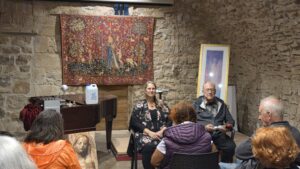
I traveled to France on a spiritual tour led by Lee Carroll, who channels Kryon, and Monika Muranyi. The journey took us through places rich in history, mystery, and spiritual traditions associated with Mary Magdalene.
During one of Lee’s channelings, Kryon delivered a powerful message to the women in the room:
Know your worth. You have always been worthy.
Kryon spoke about the historical devaluation of women and suggested that some of our deepest beliefs about women’s inferiority may have roots in ancient religious narratives.
One particular message concerned the biblical story of Adam and Eve. Kryon suggested that the original account of Genesis described Eve as being created from the dust of the earth, just as Adam was, and that the story was later changed to describe Eve as being created from Adam’s rib.
To be clear, this was a channeled spiritual message, not a documented historical finding. There is no established manuscript evidence supporting that proposed change to Genesis. I share it because of the profound emotional response it evoked.
As I listened, I began to sob. Other women around me were crying, too.
What I felt was difficult to put into words.
Part of it was relief. Part of it was pain and sadness.
It was as though something deep within me, something I hadn’t even realized I was carrying, was finally being acknowledged.
The message felt like a salve on a deep feminine wound, both my own and that of the collective.
I thought about the countless women throughout history who had been told, directly or indirectly, that they were less important, less capable, less intelligent, or less deserving than men.
And I thought about my own experiences.
When Women Are Made to Feel Less Than
I spent 25 years working in banking, a traditionally male-dominated industry.
As a woman building my career, there were times when I had to navigate situations that my male colleagues likely never experienced.
One memory stands out.
I was a young banker attending lunch with clients and my boss. During the meal, one of the clients made an unfounded rude and crude remark about my love life.
I was deeply uncomfortable.
What made it worse was that my boss said nothing. He didn’t defend me, challenge the remark, or acknowledge that it was inappropriate.
I was left to navigate the situation on my own.
Perhaps you’ve experienced something similar. Maybe you’ve been dismissed in a meeting, had your ideas overlooked, been subjected to inappropriate comments, or felt pressure to remain quiet rather than make someone else uncomfortable.
These experiences can leave an imprint.
Over time, we may internalize beliefs that we need to work harder to prove ourselves, be agreeable to be accepted, or minimize our own needs to maintain peace.
And these beliefs don’t necessarily begin with us. They can be passed down through families, cultures, and generations.
That is part of what I mean when I talk about the collective feminine wound.
During my experience in France, I felt as though some of that old pain was finally being witnessed and released.
And something remarkable happened afterward.
I began to feel better, not just emotionally, but physically.
My energy improved. My outlook on life became more positive and empowered. I also noticed improvements in my digestion and back pain.
I can’t say with certainty what caused these physical changes, but I believe the emotional and spiritual experience contributed to my overall sense of well-being.
It reinforced something I have come to understand through my own healing journey and my work as a Mind Body Spirit Coach: our emotional experiences and physical well-being can be deeply interconnected.
And it brought me back to Mary Magdalene.
Who Was Mary Magdalene, Really?

Mary Magdalene is one of the most intriguing and, I believe, misunderstood women in Christian history.
According to the four canonical Gospels, Mary Magdalene was a devoted follower of Jesus. She witnessed his crucifixion and was among the first witnesses to his resurrection.
In the Gospel of John, she is the person to whom the resurrected Jesus first appears, and she is entrusted with sharing the news with his disciples.
Yet for centuries, Mary Magdalene was widely portrayed in Western Christianity as a repentant prostitute.
Interestingly, the Bible never identifies Mary Magdalene as a prostitute.
So where did that reputation come from?
How Mary Magdalene Became Associated with Sin

In 591 A.D., Pope Gregory I delivered a homily that identified Mary Magdalene with the unnamed sinful woman described in the Gospel of Luke and with Mary of Bethany.
He also interpreted the seven demons said to have been cast out of Mary Magdalene as representing various vices.
This blending of separate biblical figures helped establish the image of Mary Magdalene as a sexually sinful woman, an interpretation that influenced Western Christian teaching, art, and culture for centuries.
But the biblical texts do not establish that these women were the same person, nor do they identify Mary Magdalene’s seven demons as sexual sins.
The Catholic Church’s 1969 liturgical reforms distinguished Mary Magdalene from the other women with whom she had traditionally been conflated. Essentially, the church dropped the idea that Mary Magdalene was a prostitute.
Then, in 2016, Pope Francis elevated her liturgical memorial to the rank of a feast, celebrated on July 22.
Mary Magdalene has long been known as the Apostle of the Apostles, a title recognizing her role in announcing Jesus’ resurrection to the disciples.
The 2016 decision gave her celebration the same liturgical rank as those of the apostles, a meaningful recognition of her importance.
Think about that for a moment.
A woman who had been characterized for centuries through a narrative of sexual sin is increasingly being recognized for her devotion, spiritual significance, and leadership.
What might that tell us about the stories we’ve inherited about women?
For a fascinating exploration of this history, I recommend the article Who Framed Mary Magdalene? published by U.S. Catholic.
Mary Magdalene and the Divine Feminine

Mary Magdalene’s story becomes even more intriguing when we explore the spiritual traditions and alternative interpretations surrounding her life.
Some writers and spiritual teachers believe Mary Magdalene was far more than a follower of Jesus. They suggest she may have been his wife, spiritual partner, or an important teacher in her own right.
The possibility that Jesus and Mary Magdalene were married became widely known through Dan Brown’s novel The Da Vinci Code, although the theory predates the book.
There is no established historical evidence that Jesus and Mary Magdalene were married. However, these interpretations continue to inspire spiritual exploration and discussion.
In some traditions, Jesus is viewed as representing the Divine Masculine, while Mary Magdalene embodies the Divine Feminine.
I find this symbolism especially meaningful.
The Divine Feminine is often associated with intuition, creativity, compassion, receptivity, nurturing, community, and healing.
The Divine Masculine is often associated with focused action, structure, protection, discernment, and purposeful direction.
These are spiritual archetypes, not qualities belonging exclusively to women or men. We all carry the capacity to express both.
When the Divine Feminine and Divine Masculine are honored and balanced, something powerful can emerge.
Rather than one dominating the other, they complement and strengthen each other.
And I believe this is part of the healing humanity is being invited to embrace.
The Power of Sacred Partnership
Lately, I’ve been noticing how powerful it can be when two people come together in partnership, bringing their individual gifts into something greater than either could create alone.
Lee Carroll and Monika Muranyi are one example. From my observations and conversations with longtime followers of Lee’s work, their partnership has brought new dimensions of warmth, collaboration, and spiritual exploration to their respective work.
I see something similar with Joy and Matt Kahn, whose partnership brings together spiritual wisdom, coaching, and practical tools for personal transformation.
During my trip to France, I also met a lovely couple I’ll call Bob and Cathy. Their partnership beautifully combined his business knowledge with her deep understanding of spiritual principles and Universal Laws. Together, they had created a flourishing life and business.
These partnerships remind me that true power doesn’t have to come through domination.
It can come through collaboration, mutual respect, and honoring one another’s gifts.
Whether or not Mary Magdalene and Jesus were partners in the way some spiritual traditions suggest, I find the possibility of their complementary roles deeply inspiring.
Why Was Feminine Power Suppressed?
This brings me to a question I’ve been pondering.
If Mary Magdalene played such an important role in Jesus’ life and ministry, why did a narrative emphasizing her supposed sexual sin become so influential?
I can’t tell you definitively why. Historians point to complex developments in biblical interpretation, theology, and cultural attitudes toward women.
But I also have my own spiritual perspective.
Women are innately powerful.
Women have the capacity to gestate and birth life, and throughout history they have also served as healers, teachers, leaders, creators, and keepers of community wisdom.
Many cultures have honored feminine divinity, although women’s actual social status has varied enormously across places and periods.
I believe that when feminine wisdom, intuition, and leadership are diminished, societies lose something essential.
And when people are taught to doubt their worth, they become easier to control.
This isn’t about women becoming more powerful than men. It’s about restoring balance and recognizing the inherent worth of every person.
For me, the rise of the Divine Feminine represents a movement away from domination and toward collaboration, compassion, authenticity, and mutual respect.
It also means recognizing the ways we may have unconsciously participated in our own diminishment.
How often have we silenced ourselves to keep the peace?
How often have we doubted our intuition?
How often have we accepted less than we deserved because we didn’t believe we could ask for more?
I know I’ve done these things.
And I suspect many of you have, too.
The Rise of the Divine Feminine and Ancestral Healing
I believe we’re living in a time when many long-held patterns are being brought into awareness.
Some of this is happening through social and cultural change. Women are increasingly challenging systems, behaviors, and beliefs that have limited their opportunities, autonomy, and safety.
And some of us are experiencing this awakening on a deeply personal and spiritual level.
Astrologer Molly McCord recently explored the completion of a roughly century-long Scorpio Venus Star Point cycle in her Substack article, The Last Scorpio Venus Star Point.
Through an astrological lens, she connects this cycle with themes of feminine power, sexuality, financial independence, relationships, autonomy, and self-worth across generations.
I find this interpretation fascinating because it speaks to something I’ve been feeling: the possibility that the healing we do today can influence the generations that follow.
Consider the women in your own family.
Your mother. Your grandmothers. Your great-grandmothers.
What opportunities did they have? What choices were unavailable to them? What did they believe about their worth, their voices, and their place in the world?
What did they teach you, consciously or unconsciously, about what it means to be a woman?
Perhaps some of those beliefs served them well in the circumstances of their lives. Others may no longer serve you.
We can honor the women who came before us without continuing every belief or limitation they inherited.
For me, that is an important part of ancestral healing.
It isn’t about blaming previous generations. It’s about becoming aware of patterns, choosing what we want to carry forward, and releasing what no longer supports our highest good.
And when we make those changes, we may model new possibilities for our children, families, communities, and future generations.
What Does the Rise of the Divine Feminine Mean for You?
You don’t have to believe that Mary Magdalene was married to Jesus. You don’t have to follow astrology or resonate with channeling.
You don’t even have to identify as spiritual to appreciate the invitation her story offers.
What if it’s time to reconsider the stories you’ve been told about your worth?
What if some of the beliefs that have held you back were never really yours to begin with?
What if you could honor your intuition, speak your truth, establish healthy boundaries, and pursue your dreams without feeling guilty or selfish?
I invite you to reflect on these questions:
- Where in my life have I made myself smaller to gain acceptance or avoid conflict?
- What beliefs about my worth or capabilities might I have inherited from my family, culture, or past experiences?
- Where am I being called to trust my intuition and speak my truth?
- What would I do differently if I fully believed I was worthy, exactly as I am?
These questions aren’t always easy to answer.
Sometimes the answers bring up sadness, anger, or grief.
I know they have for me.
But I also know how liberating it can be to recognize a limiting belief and choose something different.
That is one of the reasons I’m so passionate about the work I do as a Mind Body Spirit Coach.
We don’t have to remain bound by the beliefs and experiences of our past.
We can become more conscious of them, work through the emotions they carry, and make new choices that reflect who we truly are.
Mary Magdalene’s Message for Our Time: Remember Your Worth
When I think back on my experience in France, what stays with me most isn’t the debate over historical texts or whether particular spiritual theories can be proven.
It’s the feeling I had when I heard that message.
The relief. The sadness. The sense that something deep within me was finally being acknowledged.
And the profound recognition that I have always been worthy.
Not because of what I’ve accomplished.
Not because of how hard I’ve worked.
Not because of anyone else’s approval.
Simply because I am.
I believe Mary Magdalene’s evolving story reflects something important happening in our world today.
Women are reclaiming their voices, their wisdom, their autonomy, and their rightful place as equal participants in shaping our collective future.
It may look messy at times. Long-held wounds and injustices are coming into the light, and healing isn’t always comfortable.
But I believe there is tremendous potential for transformation.
And if there’s one thing I would want every woman reading this to know, it’s this:
You are worthy. You always have been.
You don’t have to earn it, prove it, or wait for someone else to recognize it.
Perhaps the greatest gift of the Divine Feminine awakening is remembering what has always been true.
Continue Exploring Mary Magdalene’s Story
If you’d like to explore Mary Magdalene’s history, symbolism, and spiritual significance further, here are several books I recommend. They approach the subject from different perspectives, including historical scholarship, fiction, mystical interpretation, and channeled spirituality.
- The Magdalene Line Trilogy by Kathleen McGowan: The Expected One, The Book of Love, and The Poet Prince. A trilogy of spiritual and historical fiction exploring alternative narratives surrounding Mary Magdalene.
- Jesus, My Autobiography by Tina Louise Spalding. A channeled spiritual account offering an unconventional perspective on Jesus’ life and teachings.
- Mary Magdalene Revealed by Meggan Watterson. An exploration of the Gospel of Mary through a contemporary feminist and spiritual lens.
- The Gospel of the Beloved Companion by Jehanne de Quillan. An alternative text presented as a gospel associated with Mary Magdalene.
- The Gnostic Gospels by Elaine Pagels. A scholarly exploration of early Christian texts, beliefs, and the diversity of early Christianity.
You can also read my companion blog, Following Mary Magdalene Through Southern France: A Journey of Healing and Awakening, where I share more about the sacred places we visited and my experiences traveling through southern France.
An Invitation to Reclaim Your Worth
If this article resonates with you, perhaps you’re being called to explore the beliefs, experiences, or inherited patterns that have kept you from fully embracing your worth.
Through spiritual coaching, I help people gain clarity, release limiting beliefs, reconnect with their inner wisdom, and create lives that feel more authentic, joyful, and fulfilling.
If you’re ready to explore what’s possible for you, I invite you to schedule a complimentary 30-minute discovery call.
You are worthy of living a life you love.
Live the Song of Your Soul.
I’d love to hear from you. What does the rise of the Divine Feminine mean to you? Have you experienced a moment when you recognized your own worth in a new way? Share your thoughts in the comments.
Author’s note: This article combines historical information, personal experiences, and spiritual interpretations. Some ideas discussed, including channeling, astrology, and alternative accounts of Mary Magdalene’s life, are matters of belief rather than established historical fact. I encourage you to explore the sources, trust your discernment, and form your own conclusions.